The conversation
On October 28, 2026, the SoCO Research Workshop brought clinicians, investigators, editors, and industry colleagues together to discuss how authorship decisions are made. Three cases anchored the conversation: the clinician whose patients generated the data, the expert invited after a draft exists, and the investigator navigating a multicenter trial.
The discussion repeatedly returned to a practical problem: people can know the same authorship criteria and still disagree about the contribution required, the opportunity to make that contribution, or the order in which contributors should appear. Hearing how colleagues have handled those situations was as important as reviewing the rules.
The room
People who joined
43
Colleagues represented in the meeting
Median time together
93.5 min
Median recorded attendance per person
Stayed at least an hour
88%
38 of 43 people attended for at least 60 minutes
From the October 28 meeting attendance records. Survey response counts reflect the people who answered each question.
The practical question
How do we give people a meaningful opportunity to contribute, make decisions understandable, and revisit them as the work changes?
A shared starting point
The workshop used ICMJE’s four-part framework: substantial input into the study’s design, data collection, analysis, or interpretation; drafting or substantive intellectual review; approval of the final manuscript; and accountability for questions about its accuracy or integrity. All four are required. The author group should include everyone who fulfills them, and people meeting the first requirement should have an opportunity to complete the manuscript-related requirements. [1]
The opening distinguished that threshold from COPE’s publication-ethics guidance, CRediT’s vocabulary for describing contributions, and individual journal policies. CRediT describes work performed; it does not independently decide who qualifies as an author. [2] [3]
Ade Adamson described what an editor can realistically assess. A journal sees the submitted paper and contribution statements, not every interaction that produced them. Mike Wong emphasized the culture and leadership through which groups apply the criteria. Their comments placed much of the practical responsibility within the research team, before submission.
What the community survey added
Familiar with ICMJE
67%
30 of 45 were very or somewhat familiar
Very familiar
24%
11 of 45 selected the highest familiarity category
Often or always use guidance
36%
16 of 45; 8 additional respondents chose not applicable
The distinction between familiarity and use mattered. Familiarity was common, but a smaller group reported being very familiar, and use of formal guidance varied. These were self-reports from a community survey, not an audit of whether contributors met authorship requirements.
Question-specific denominators are shown throughout the figures. The survey used several perspective-based question sets; answering an investigator or publication-team question does not by itself verify someone’s employment sector. The complete chart collection, including questions not reached during the meeting, is available below.
Case 1 · Clinical contribution and a meaningful opportunity
The first case concerned a clinician whose patient care substantially supported a retrospective study but who had not participated in its design, analysis, interpretation, or writing. The central question was what a meaningful invitation into the research should look like.
In the survey: 26 of 35 respondents (74%) selected the view that care alone is insufficient but clinicians should generally be offered an opportunity to contribute further. Among the 33 respondents to the clinician-reaction question, 26 (79%) would be somewhat or very bothered if they were not approached.
Kevin Emerick described moving from late requests to approve a finished case series toward engagement when the question is first taking shape. Examples included continuing a conversation after tumor board, setting aside a project or lab meeting, and offering office hours to review the data and challenge the interpretation. David Miller described an office-hours invitation that resulted in an engaged author group.
Elizabeth Buchbinder emphasized the research work embedded in clinical practice: obtaining tissue, arranging banking consent, supporting ctDNA collection, and documenting information so that it can be analyzed reliably. These contributions can be easy to miss if a project team first contacts clinicians when the manuscript is nearly complete. Early involvement was discussed as a way to improve the science as well as clarify credit.
Study-lead question
Which best reflects your view?
n = 35
Single choice
Caring for the patients whose data make the study possible should itself carry meaningful weight toward authorship
23%
8 / 35
Clinical care alone is not enough for authorship, but those clinicians should generally be offered an opportunity to contribute further
74%
26 / 35
Authorship should depend only on contributions to the research itself, regardless of who provided the clinical care
3%
1 / 35
Study-lead question, n = 35. The opportunity-to-contribute answer received 26 responses (74%).
Case 2 · The late invited expert
This case began with a different relationship to the work: an academic expert had not treated the patients or participated in the study, and the manuscript was already substantially drafted. The question was whether enough meaningful intellectual work remained for the expert to qualify and accept responsibility.
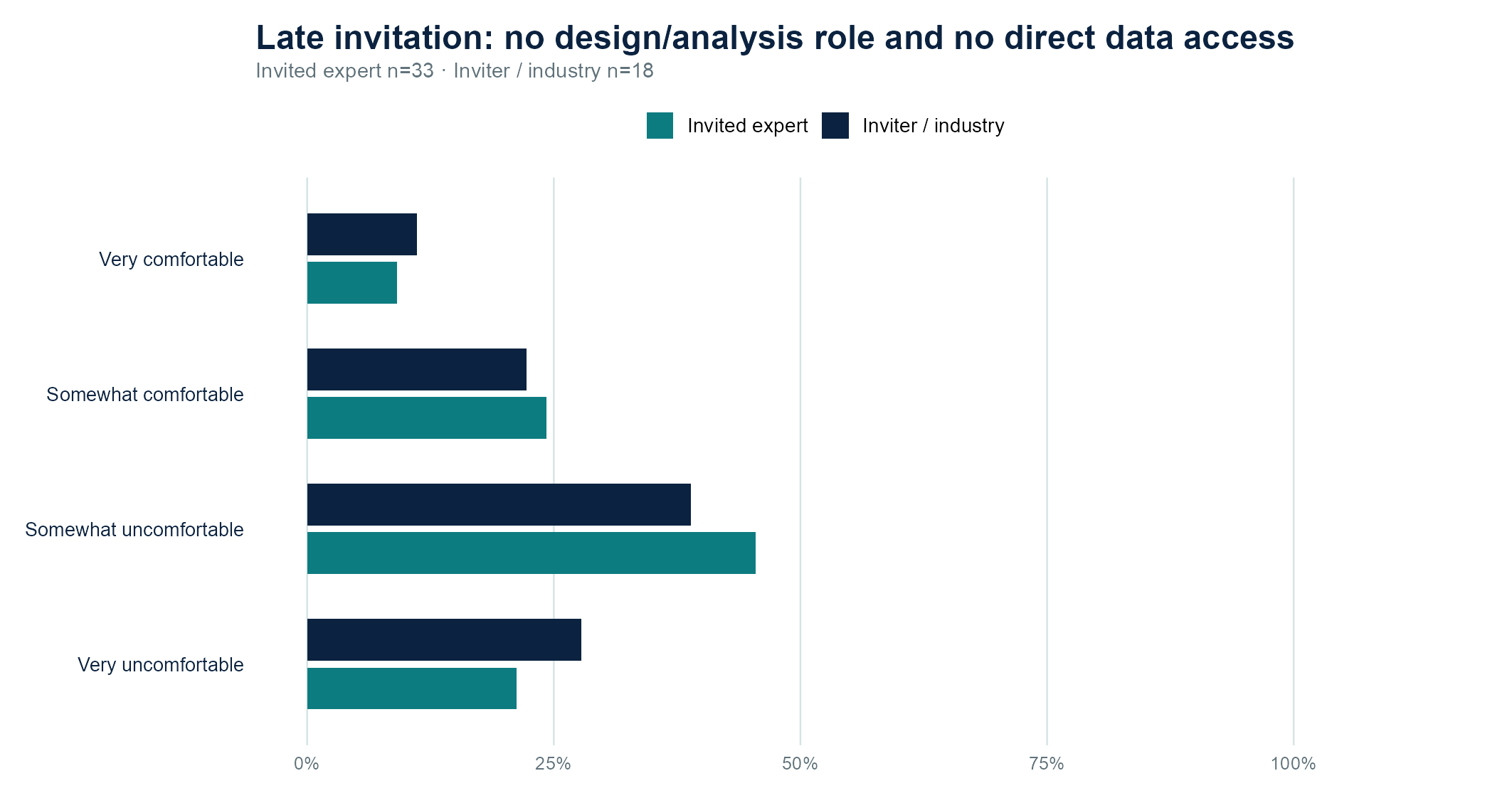
In the survey: 22 of 33 respondents (67%) were somewhat or very uncomfortable accepting late authorship without direct access to the underlying data. In a separate question, 18 of 33 (55%) said they had declined a late invitation because they did not feel their contribution justified authorship.
Mike Wong’s personal test was whether he could defend the paper in front of peers. Elizabeth Buchbinder distinguished an invitation to help shape interpretation from an invitation to endorse a finished product. Daniel Coit offered another perspective: a rigorous internal review can have intellectual value, even when the reviewer ultimately endorses the existing analysis. The group did not settle a universal threshold for how much interpretive input is enough.
Howard Kaufman described legitimate reasons to seek expertise outside an existing team and the value of doing so early. He also explained the internal reviews that may surround industry publications, including scientific, publication-planning, conflict-of-interest, partner, and intellectual-property considerations. The discussion made clear why timing, access, and freedom to challenge conclusions belong in the invitation itself.
Invited-expert question
Have you ever declined a late invitation to authorship because you did not feel your contribution justified authorship?
n = 33
Single choice
Not sure / don't recall
9%
3 / 33
Late-invitation question, n = 33. Eighteen respondents (55%) reported having declined because their contribution did not justify authorship.
Case 3 · Clinical trials, author order, and competing expectations
The third case expanded the problem across investigators, sites, specialties, and publication teams. Elizabeth Buchbinder described how authorship conversations can be more direct in small early-phase studies and more remote in larger programs. Expectations about enrollment, scientific input, and lead roles may develop well before a manuscript appears.
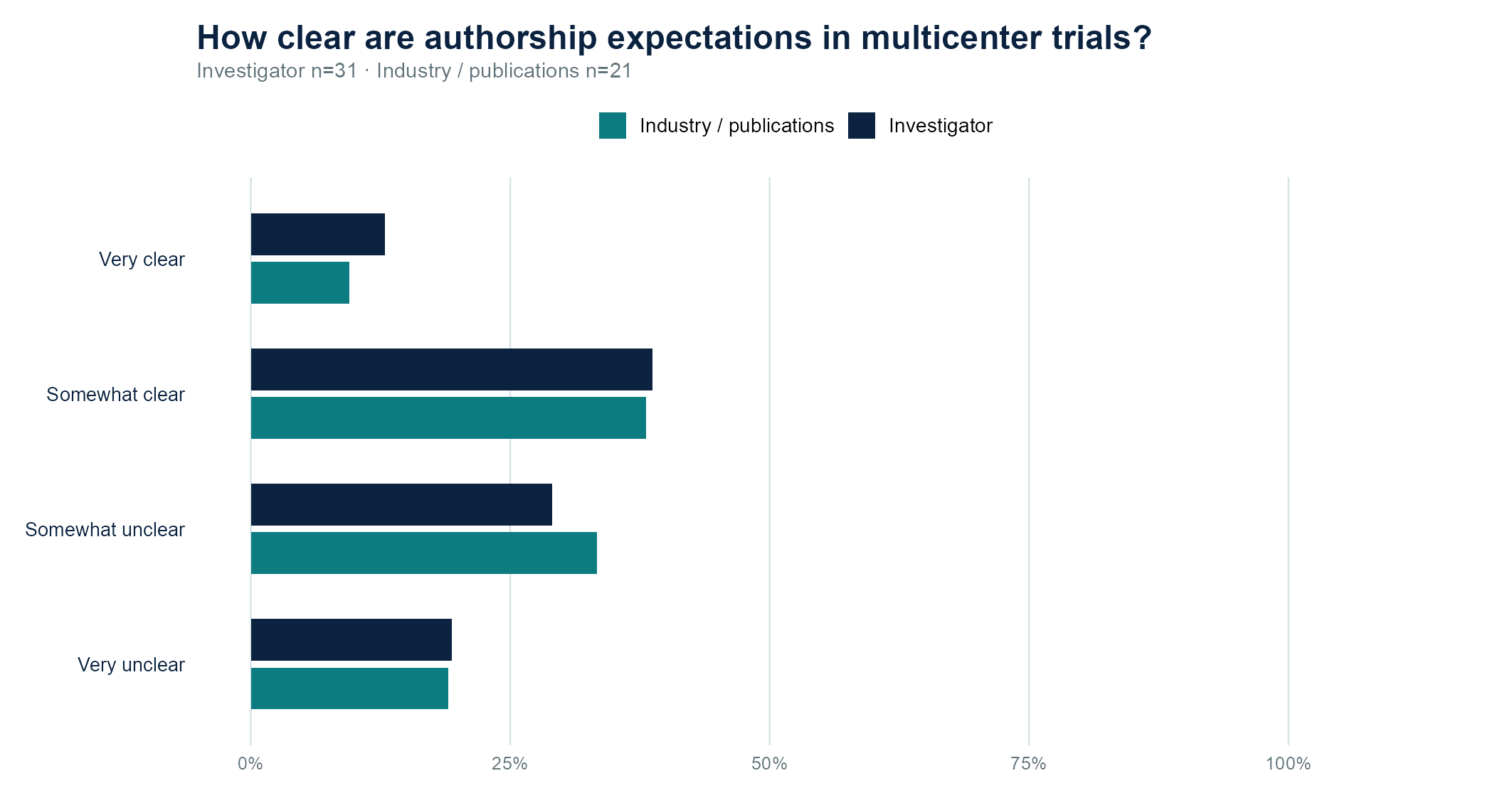
In the survey: only 4 of 31 respondents (13%) to the investigator-expectations question said authorship expectations were very clear. The separate publication-team question had 21 responses. Those are question-specific response counts, not verified counts of academics and industry employees.
Raj Patel described how publication planning may consider enrollment, data quality, scientific insights, relevant expertise, and earlier conversations with the clinical team. He identified opportunities to contribute during a trial: investigator meetings, suggestions for additional analyses, and communication with clinical or medical teams. These were descriptions of practice and experience, not a single policy governing every sponsor.
The exchange also exposed difficult tradeoffs. Additional authors require coordination, while a one-author-per-site convention can obscure contributions from surgeons, pathologists, and other specialists. The chat raised equity across sites and the risk of rewarding whoever presses hardest. Author order drew particular concern, including unclear decision rules and the repeated selection of established names for leading positions.
Elizabeth Buchbinder raised the implications for advancement of other investigators. Kamaneh Montazeri described the importance of negotiating multidisciplinary roles early. Danielle Brazel connected publication pressure to trainee incentives, and Mike Wong argued for assessing collaborative success more directly. These comments widened the discussion from manuscript administration to the institutions that assign value to a byline.
Investigator question
Before agreeing to participate in a multicenter clinical trial, how clear are you usually about whether your contribution could lead to authorship?
n = 31
Single choice
Somewhat clear
39%
12 / 31
Somewhat unclear
29%
9 / 31
Publication-team question
Before a site agrees to participate in a multicenter clinical trial, how clear are the authorship expectations typically made to investigators?
n = 21
Single choice
Somewhat clear
38%
8 / 21
Somewhat unclear
33%
7 / 21
These are question-specific response sets. The perspective labels do not verify mutually exclusive employment groups.
The acknowledgment debate remained open
Daniel Coit proposed more deliberate recognition of contributors whose work mattered but who did not fulfill all four authorship requirements. Later discussion returned to surgeons, pathologists, referring clinicians, and others whose contributions can be difficult to see in a conventional byline.
Participants differed over whether acknowledgment offers meaningful recognition when promotion and other academic rewards remain tied to authorship. David Miller argued for taking that recognition more seriously. Kenneth Tsai emphasized that an individual’s good intentions cannot change institutional incentives and noted that several members of a research team can be overlooked.
The exchange left two questions worth carrying forward: how to record important work fairly now, and how institutions could recognize that work more fully. Acknowledgment cannot replace authorship someone has earned. When non-author contributors are named, their contribution and permission to be acknowledged also matter. [1]
Four habits for the next collaboration
The discussion closed with four practical habits for approaching authorship:
Earlier
Invite people while they can still shape the question, analysis, interpretation, or manuscript.
Explicitly
State expected contributions, responsibilities, and the basis for inclusion and leading roles.
Transparently
Explain how decisions about inclusion and author order are made, including changes to the plan.
Revisited
Return to the plan as contributions and availability change.
These habits offer a practical way to start the next conversation. They also leave room for what participants valued throughout the session: a colleague’s experience to draw on when an invitation or authorship decision feels difficult.
Thank you for the conversation
Discussion leads brought editorial, clinical, investigative, and publication-team perspectives to the cases.
Ade Adamson
Kevin S. Emerick
Michael K. Wong
Howard L. Kaufman
Elizabeth I. Buchbinder
Raj Patel
The recorded exchange also included substantive contributions from Vishal Patel, Daniel Coit, Danielle Brazel, Kamaneh Montazeri, and Kenneth Tsai, alongside the questions and perspectives shared in the chat. Thank you to everyone who participated and completed the survey.
Who joined us?
43 colleagues · alphabetical roster
An alphabetical roster of colleagues who joined the workshop.
- Adewole S. Adamson
- Adewunmi O. Adelaja
- Ahmad Naim
- Ajay Nair Sharma
- Aleigha R. Lawless
- Alfredo Covelli
- Alyssa Lee
- Cara Trulli
- Christine C. Cimoch
- Christopher Zajac
- Daniel Coit
- Danielle M. Brazel
- David M. Miller
- Desiree Ratner
- Elizabeth I. Buchbinder
- Frances Collichio
- Govind Warrier
- Gregory Norigian
- Howard L. Kaufman
- Isaac Brownell
- Jessica L. Fewkes
- Jonathan A. Dyer
- Joseph Grossman
- Juliane Andrade Czapla
- Kamaneh Montazeri
- Kenneth Y. Tsai
- Kevin S. Emerick
- Laura Ferris
- Lauren Fleshner
- Leon Sakkal
- Lisa Zaba
- Manisha Thakuria
- Maya Dimitrova
- Mehran Behruj Yusuf
- Michael K. K. Wong
- Patrick Kurpaska
- Raj Patel
- Sameer Gupta
- Sara Behbahani
- Suzanne Topalian
- Tatyana Sharova
- Vishal Anil Patel
- William J. Benjamin IV
Explore the complete survey
Every result item in the supplied aggregate export is included below, with all answer choices, counts, and question-specific denominators. Multi-select items can total more than 100%; ranked views show first-choice responses only.
These responses describe the SoCO survey participants who answered each item. Perspective labels identify the question being answered; they do not establish mutually exclusive employment groups. The survey is a descriptive community snapshot.
49 result items available · 1 additional item without exported results
Background and the value of authorship
14 result items · 1 unavailable
Community survey
Which best describes your primary professional setting?
n = 45
Single choice
Academic medical center / university
80%
36 / 45
Community or private practice
2%
1 / 45
Government / regulatory agency
0%
0 / 45
Research institute
0%
0 / 45
Community survey
Which best describes your current career stage?
n = 37
Single choice
Resident / fellow
3%
1 / 37
Early-career faculty / professional
22%
8 / 37
Mid-career faculty / professional
32%
12 / 37
Senior faculty / professional
32%
12 / 37
Emeritus / retired
3%
1 / 37
Community survey
Which best describes your current role level?
n = 8
Single choice
Senior / leadership
38%
3 / 8
Community survey · Topic heading
Professional background
n = 43
Single choice
Advanced practice clinician (NP or PA)
2%
1 / 43
Research scientist / investigator
2%
1 / 43
Epidemiologist / biostatistician / data scientist
0%
0 / 43
Other scientific or technical professional
0%
0 / 43
Business / management / administration
2%
1 / 43
Other healthcare professional
0%
0 / 43
Other professional background
2%
1 / 43
Community survey · Topic heading
Current areas of professional work or training
n = 45
Multiple selections allowed · percentages may total more than 100%
Not yet specialized / general training
0%
0 / 45
Dermatology / Mohs surgery
29%
13 / 45
Medical oncology / hematology-oncology
42%
19 / 45
Surgery / surgical oncology
11%
5 / 45
Radiation oncology
9%
4 / 45
Pathology / dermatopathology
2%
1 / 45
Otolaryngology / head and neck surgery
4%
2 / 45
Other clinical specialty
2%
1 / 45
Basic / translational research
11%
5 / 45
Epidemiology / biostatistics / data science
7%
3 / 45
Clinical development
9%
4 / 45
Medical affairs
7%
3 / 45
Publications / medical communications / editorial
2%
1 / 45
Regulatory / government
0%
0 / 45
Executive / organizational leadership
16%
7 / 45
Community survey · Topic heading
First-ranked area of professional work or training
n = 14
Ranked responses · first choice only
Not yet specialized / general training
0%
0 / 14
Dermatology / Mohs surgery
36%
5 / 14
Medical oncology / hematology-oncology
21%
3 / 14
Surgery / surgical oncology
14%
2 / 14
Radiation oncology
7%
1 / 14
Pathology / dermatopathology
0%
0 / 14
Otolaryngology / head and neck surgery
7%
1 / 14
Other clinical specialty
0%
0 / 14
Basic / translational research
7%
1 / 14
Epidemiology / biostatistics / data science
0%
0 / 14
Clinical development
0%
0 / 14
Medical affairs
0%
0 / 14
Publications / medical communications / editorial
0%
0 / 14
Regulatory / government
0%
0 / 14
Executive / organizational leadership
7%
1 / 14
Community survey
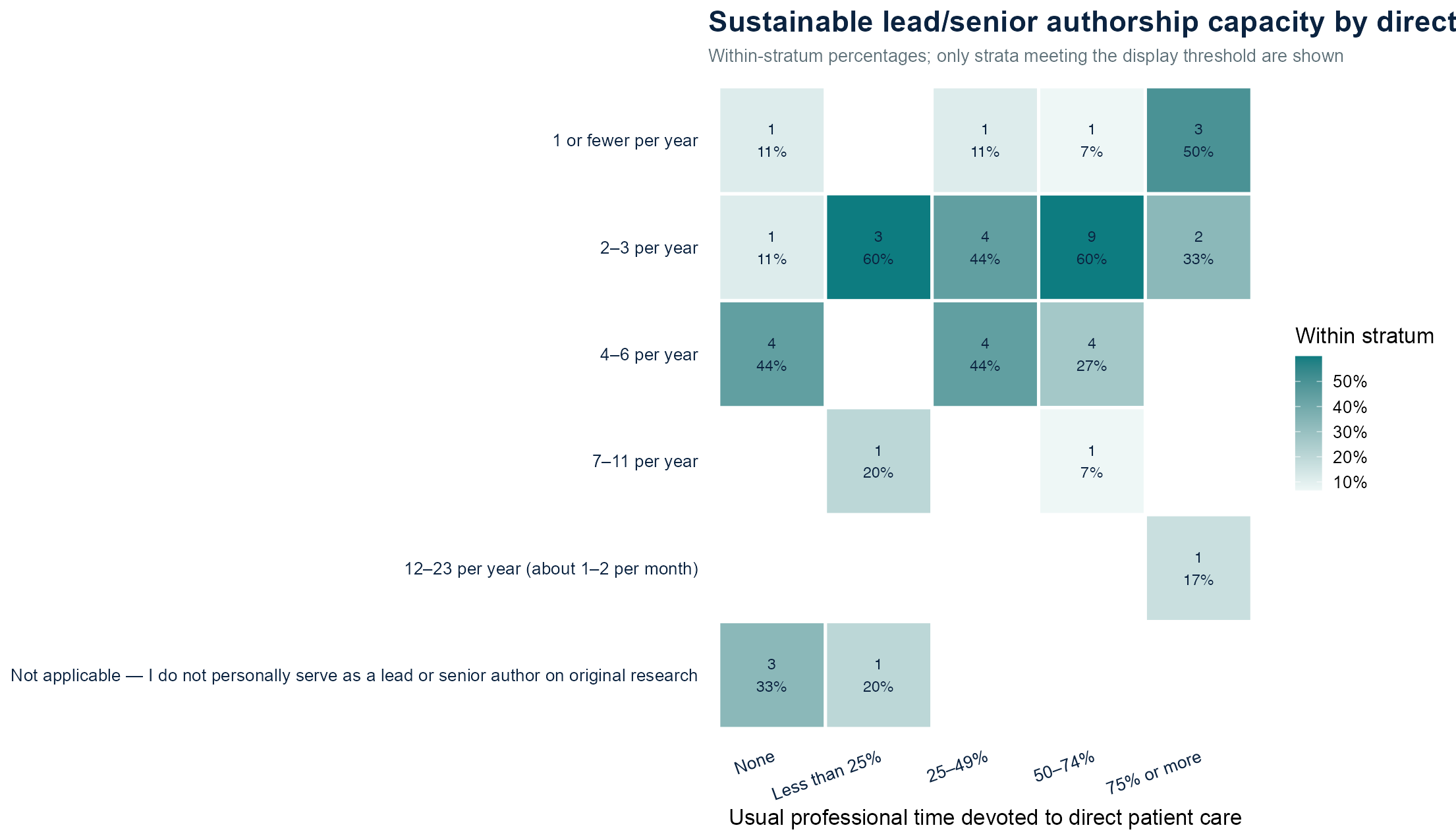
Approximately what proportion of your usual professional time is devoted to direct patient care?
n = 45
Single choice
Community survey
Approximately how many peer-reviewed publications have you authored?
n = 45
Single choice
More than 100
29%
13 / 45
Community survey
Have you ever served in a formal editorial role for a peer-reviewed journal?
n = 45
Single choice
Yes, currently
31%
14 / 45
Yes, previously
11%
5 / 45
Community survey
Why is authorship valuable to you professionally?
n = 45
Multiple selections allowed · percentages may total more than 100%
Sharing findings and ideas with the field
60%
27 / 45
Making a lasting contribution to the scientific literature
51%
23 / 45
Receiving appropriate credit for my contributions
27%
12 / 45
Building my professional reputation, expertise, or leadership in a field
44%
20 / 45
Advancing my career or creating future professional opportunities
29%
13 / 45
Supporting grant or funding opportunities
7%
3 / 45
Building collaborations and professional relationships
36%
16 / 45
Meeting expectations of my institution, company, or professional role
16%
7 / 45
Authorship is not particularly important to my current professional goals
7%
3 / 45
Community survey
Of the reasons you selected, how would you rank their importance to you?
n = 40
Ranked responses · first choice only
Sharing findings and ideas with the field
40%
16 / 40
Making a lasting contribution to the scientific literature
25%
10 / 40
Receiving appropriate credit for my contributions
8%
3 / 40
Building my professional reputation, expertise, or leadership in a field
12%
5 / 40
Advancing my career or creating future professional opportunities
5%
2 / 40
Supporting grant or funding opportunities
0%
0 / 40
Building collaborations and professional relationships
10%
4 / 40
Meeting expectations of my institution, company, or professional role
0%
0 / 40
Authorship is not particularly important to my current professional goals
0%
0 / 40
Community survey
Suppose authorship had no effect on hiring, promotion, funding, compensation, or professional reputation. How important would being an author still be to you?
n = 45
Single choice
Very important
42%
19 / 45
Somewhat important
40%
18 / 45
Not very important
11%
5 / 45
Not important at all
7%
3 / 45
Community survey
Compared with other meaningful professional contributions—such as clinical care, research, teaching, mentorship, collaboration, program or product development, and organizational leadership—how much weight does authorship receive in career advancement and professional recognition in your environment?
n = 45
Single choice
Somewhat too little
0%
0 / 45
About the right amount
31%
14 / 45
Somewhat too much
27%
12 / 45
Not sure / not applicable
13%
6 / 45
Community survey · Topic heading
Experience with authorship situations
n = 45
Multiple selections allowed · percentages may total more than 100%
I have been invited to join an abstract or manuscript late in its development
73%
33 / 45
I have been involved in deciding to invite an external expert to join an abstract or manuscript late in its development
40%
18 / 45
I have cared for patients whose clinical data were later used in retrospective research
73%
33 / 45
I have led or participated in retrospective research using data from patients cared for by clinicians who were not otherwise involved in the research
78%
35 / 45
I have participated as an investigator in a multicenter clinical trial
69%
31 / 45
I have been involved in publication planning or authorship decisions for multicenter clinical trials
47%
21 / 45
I have participated in a Delphi, consensus panel, guideline, or similar project that resulted in a publication
56%
25 / 45
I have organized or led a Delphi, consensus panel, guideline, or similar project that resulted in a publication
20%
9 / 45
None of the above
2%
1 / 45
Community survey · Topic heading
Career stage: government or regulatory work
Unavailable
This item appeared in the earlier figure archive, but its results were not included in the supplied aggregate export. No response count or denominator is inferred.
Guidelines and editorial perspectives
4 result items
Community survey
How familiar are you with the International Committee of Medical Journal Editors (ICMJE) authorship criteria?
n = 45
Single choice
Very familiar
24%
11 / 45
Somewhat familiar
42%
19 / 45
Slightly familiar
9%
4 / 45
Not at all familiar
24%
11 / 45
Community survey
How often do you use the ICMJE criteria or other formal authorship guidance when making authorship decisions?
n = 45
Single choice
Not applicable
18%
8 / 45
Editorial perspective · Topic heading
What raises concern about authorship?
n = 19
Multiple selections allowed · percentages may total more than 100%
Contribution statements are vague or do not clearly distinguish individual roles
11%
2 / 19
Some authors appear to have contributed primarily through patient enrollment or data provision, with little other involvement
0%
0 / 19
Some authors appear to have had little involvement in interpretation or manuscript review/revision
11%
2 / 19
It is unclear whether all authors approved the final manuscript
16%
3 / 19
It is unclear whether all authors can accept accountability for the work
16%
3 / 19
A senior or well-known author appears to have been added without a clearly documented contribution
16%
3 / 19
The author list is difficult to reconcile with the scope of the work and the stated contributions
26%
5 / 19
I generally rely on the authors' attestation unless there is specific information suggesting a problem
53%
10 / 19
Editorial perspective · Topic heading
The journal’s role when an authorship concern arises
n = 19
Single choice
The journal should generally accept the author group's attestation unless there is clear evidence of a problem
5%
1 / 19
The journal should ask for clarification or more detailed contribution statements when concerns arise
84%
16 / 19
The journal should require the authors to resolve the issue before publication
5%
1 / 19
The journal should involve the relevant institution(s) when a substantial dispute cannot be resolved
5%
1 / 19
Case 1 · Clinical contribution
4 result items
Clinician question
If a substantial portion of the study population came from patients you cared for, how strongly would you feel that you should be offered an opportunity to participate as an author?
n = 33
Single choice
Scenario: A retrospective study is performed using clinical data from patients seen within a practice or multidisciplinary group. Some clinicians cared for many of the patients whose records form the dataset but were not involved in developing the research question, designing the study, analyzing the data, or drafting the manuscript.
Somewhat strongly
48%
16 / 33
Not very strongly
21%
7 / 33
Clinician question
If you were not approached about authorship in that situation, how bothered would you be?
n = 33
Single choice
Scenario: A retrospective study is performed using clinical data from patients seen within a practice or multidisciplinary group. Some clinicians cared for many of the patients whose records form the dataset but were not involved in developing the research question, designing the study, analyzing the data, or drafting the manuscript.
Very bothered
30%
10 / 33
Somewhat bothered
48%
16 / 33
Not very bothered
18%
6 / 33
Not bothered at all
3%
1 / 33
Study-lead question
If clinicians were substantially responsible for the care that generated the data used in the study, how strongly do you feel an obligation to offer them an opportunity to contribute toward authorship?
n = 35
Single choice
Scenario: A retrospective study is performed using clinical data from patients seen within a practice or multidisciplinary group. Some clinicians cared for many of the patients whose records form the dataset but were not involved in developing the research question, designing the study, analyzing the data, or drafting the manuscript.
Very strongly
29%
10 / 35
Somewhat strongly
63%
22 / 35
Not very strongly
9%
3 / 35
Study-lead question
Which best reflects your view?
n = 35
Single choice
Scenario: A retrospective study is performed using clinical data from patients seen within a practice or multidisciplinary group. Some clinicians cared for many of the patients whose records form the dataset but were not involved in developing the research question, designing the study, analyzing the data, or drafting the manuscript.
Caring for the patients whose data make the study possible should itself carry meaningful weight toward authorship
23%
8 / 35
Clinical care alone is not enough for authorship, but those clinicians should generally be offered an opportunity to contribute further
74%
26 / 35
Authorship should depend only on contributions to the research itself, regardless of who provided the clinical care
3%
1 / 35
Case 2 · The late invited expert
9 result items
Invited-expert question · Topic heading
Comfort accepting a late authorship invitation
n = 33
Single choice
Very comfortable
12%
4 / 33
Somewhat comfortable
42%
14 / 33
Somewhat uncomfortable
33%
11 / 33
Very uncomfortable
12%
4 / 33
Invited-expert question
Have you ever declined a late invitation to authorship because you did not feel your contribution justified authorship?
n = 33
Single choice
Scenario: A recognized expert is invited to review an abstract or manuscript shortly before submission. They were not involved in the original study.
Not sure / don't recall
9%
3 / 33
Invited-expert question · Topic heading
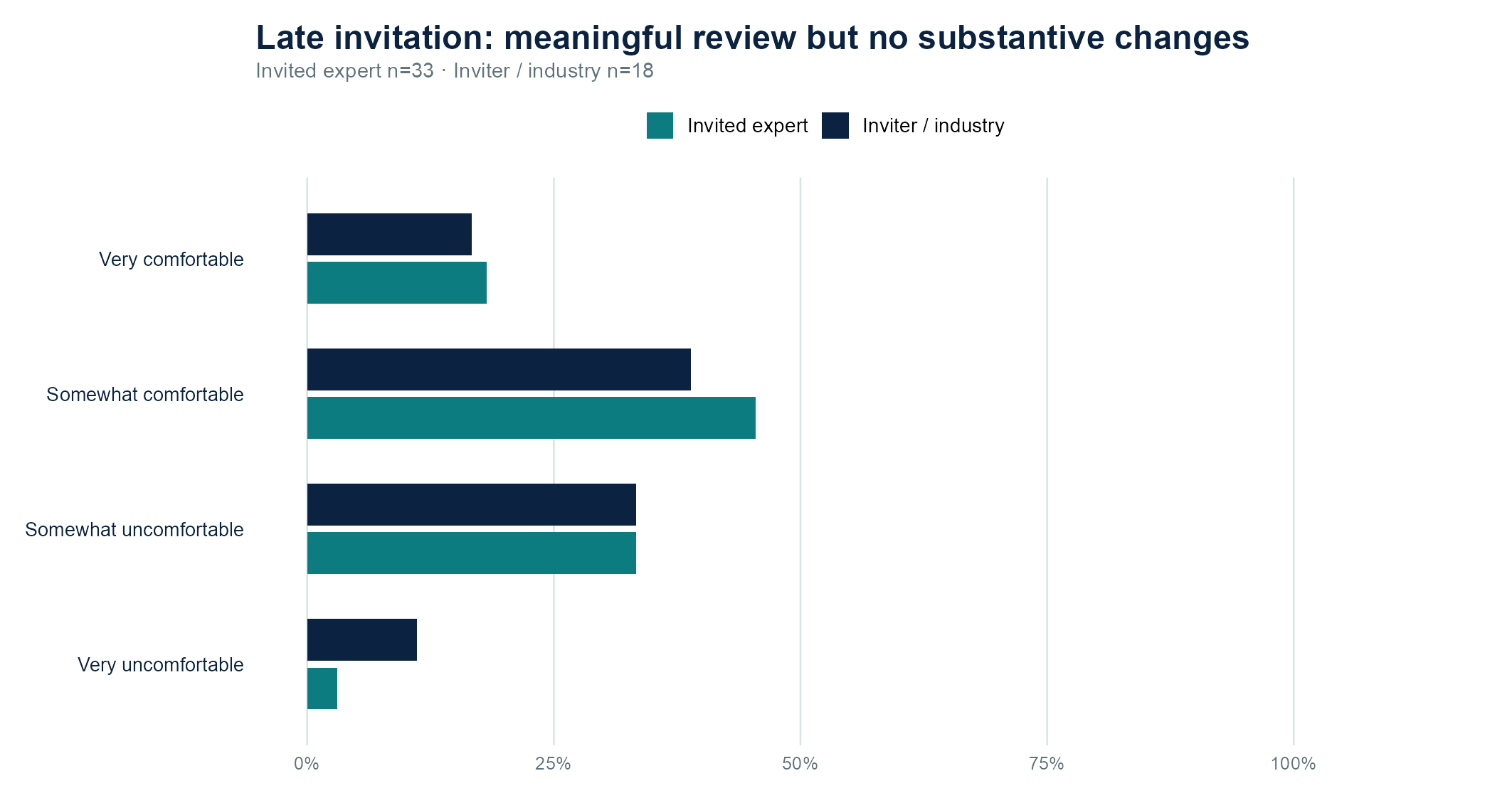
Accepting authorship after a review that leaves the manuscript unchanged
n = 33
Single choice
Very comfortable
18%
6 / 33
Somewhat comfortable
45%
15 / 33
Somewhat uncomfortable
33%
11 / 33
Very uncomfortable
3%
1 / 33
Invited-expert question
Suppose you were not involved in the study design or analysis and did not have direct access to the underlying data. How comfortable would you be accepting authorship?
n = 33
Single choice
Scenario: A recognized expert is invited to review an abstract or manuscript shortly before submission. They were not involved in the original study.
Very comfortable
9%
3 / 33
Somewhat comfortable
24%
8 / 33
Somewhat uncomfortable
45%
15 / 33
Very uncomfortable
21%
7 / 33
Inviting-team question · Topic heading
Comfort offering a late authorship invitation
n = 18
Single choice
Very comfortable
6%
1 / 18
Somewhat comfortable
44%
8 / 18
Somewhat uncomfortable
39%
7 / 18
Very uncomfortable
11%
2 / 18
Inviting-team question · Topic heading
Offering authorship after a review that leaves the manuscript unchanged
n = 18
Single choice
Very comfortable
17%
3 / 18
Somewhat comfortable
39%
7 / 18
Somewhat uncomfortable
33%
6 / 18
Very uncomfortable
11%
2 / 18
Inviting-team question
Suppose the invited expert was not involved in the study design or analysis and did not have direct access to the underlying data. How comfortable would you be continuing to offer authorship?
n = 18
Single choice
Scenario: A recognized expert is invited to review an abstract or manuscript shortly before submission. They were not involved in the original study.
Very comfortable
11%
2 / 18
Somewhat comfortable
22%
4 / 18
Somewhat uncomfortable
39%
7 / 18
Very uncomfortable
28%
5 / 18
Inviting-team question · Topic heading
Considerations behind an external expert’s late invitation
n = 18
Multiple selections allowed · percentages may total more than 100%
Their scientific or clinical expertise is expected to improve the interpretation or presentation of the work
100%
18 / 18
The invitation recognizes contributions they made to the broader study or program that are not fully reflected in this specific manuscript
72%
13 / 18
Their inclusion provides representation for an important investigator, site, discipline, or collaborating group
61%
11 / 18
Their professional standing is expected to strengthen the credibility, visibility, or impact of the work
72%
13 / 18
The invitation helps maintain or strengthen an important professional collaboration or relationship
50%
9 / 18
Inviting-team question · Topic heading
The primary consideration behind a late invitation
n = 18
Single choice
Their scientific or clinical expertise is expected to improve the interpretation or presentation of the work
78%
14 / 18
The invitation recognizes contributions they made to the broader study or program that are not fully reflected in this specific manuscript
0%
0 / 18
Their inclusion provides representation for an important investigator, site, discipline, or collaborating group
6%
1 / 18
Their professional standing is expected to strengthen the credibility, visibility, or impact of the work
6%
1 / 18
The invitation helps maintain or strengthen an important professional collaboration or relationship
11%
2 / 18
Case 3 · Clinical trial authorship
12 result items
Investigator question
Before agreeing to participate in a multicenter clinical trial, how clear are you usually about whether your contribution could lead to authorship?
n = 31
Single choice
Scenario: For investigators participating in multicenter trials, two questions are often left unclear: Will my contribution lead to authorship? If so, where will I appear on the paper?
Somewhat clear
39%
12 / 31
Somewhat unclear
29%
9 / 31
Publication-team question
Before a site agrees to participate in a multicenter clinical trial, how clear are the authorship expectations typically made to investigators?
n = 21
Single choice
Scenario: For investigators participating in multicenter trials, two questions are often left unclear: Will my contribution lead to authorship? If so, where will I appear on the paper?
Somewhat clear
38%
8 / 21
Somewhat unclear
33%
7 / 21
Investigator question
In your experience, which factor most strongly determines whether an investigator is included as an author on the primary trial publication?
n = 31
Single choice
Scenario: For investigators participating in multicenter trials, two questions are often left unclear: Will my contribution lead to authorship? If so, where will I appear on the paper?
Patient enrollment / accrual
42%
13 / 31
Site principal investigator role
10%
3 / 31
Scientific or intellectual contribution
10%
3 / 31
Participation in trial leadership or steering committees
23%
7 / 31
Contribution to data interpretation or manuscript development
3%
1 / 31
Prespecified publication-plan rules
3%
1 / 31
Sponsor/publication-team discretion
6%
2 / 31
Publication-team question
When deciding which trial investigators are included as authors on the primary publication, which consideration most often carries the greatest weight?
n = 21
Single choice
Scenario: For investigators participating in multicenter trials, two questions are often left unclear: Will my contribution lead to authorship? If so, where will I appear on the paper?
Patient enrollment / accrual
38%
8 / 21
Site principal investigator role
14%
3 / 21
Scientific or intellectual contribution
14%
3 / 21
Participation in trial leadership or steering committees
29%
6 / 21
Contribution to data interpretation or manuscript development
0%
0 / 21
Prespecified publication-plan rules
0%
0 / 21
Fair representation across participating sites
0%
0 / 21
Keeping the total author list manageable
0%
0 / 21
Investigator relationships and engagement
0%
0 / 21
Investigator question · Topic heading
Investigator perspective: what drives author order?
n = 31
Single choice
Patient enrollment / accrual
32%
10 / 31
Site principal investigator role
6%
2 / 31
Scientific or intellectual contribution
10%
3 / 31
Participation in trial leadership or steering committees
29%
9 / 31
Contribution to data interpretation or manuscript development
0%
0 / 31
Prespecified publication-plan rules
6%
2 / 31
Sponsor/publication-team discretion
10%
3 / 31
Publication-team question · Topic heading
Publication-team perspective: what drives author order?
n = 21
Single choice
Patient enrollment / accrual
38%
8 / 21
Site principal investigator role
5%
1 / 21
Scientific or intellectual contribution
14%
3 / 21
Participation in trial leadership or steering committees
24%
5 / 21
Contribution to data interpretation or manuscript development
5%
1 / 21
Prespecified publication-plan rules
0%
0 / 21
Fair representation across participating sites
5%
1 / 21
Sponsor/publication-team discretion
5%
1 / 21
Investigator question · Topic heading
Investigator perspective: a one-author-per-site limit
n = 31
Single choice
Very comfortable
0%
0 / 31
Somewhat comfortable
13%
4 / 31
Somewhat uncomfortable
42%
13 / 31
Very uncomfortable
45%
14 / 31
Publication-team question · Topic heading
Publication-team perspective: a one-author-per-site limit
n = 21
Single choice
Very comfortable
5%
1 / 21
Somewhat comfortable
19%
4 / 21
Somewhat uncomfortable
33%
7 / 21
Very uncomfortable
43%
9 / 21
Investigator question
When authorship expectations are discussed before or during a trial, who most often initiates that conversation?
n = 31
Single choice
Scenario: For investigators participating in multicenter trials, two questions are often left unclear: Will my contribution lead to authorship? If so, where will I appear on the paper?
Someone on the investigator / site team
19%
6 / 31
Someone on the sponsor / company team
16%
5 / 31
Clinical operations / trial management / CRO
3%
1 / 31
It is usually raised jointly by the investigator and sponsor teams
10%
3 / 31
It varies substantially from trial to trial
29%
9 / 31
Authorship expectations are usually not discussed explicitly
23%
7 / 31
Publication-team question
When authorship expectations are discussed before or during a trial, who most often initiates that conversation?
n = 20
Single choice
Scenario: For investigators participating in multicenter trials, two questions are often left unclear: Will my contribution lead to authorship? If so, where will I appear on the paper?
Someone on the investigator / site team
30%
6 / 20
Someone on the sponsor / company team
30%
6 / 20
Clinical operations / trial management / CRO
0%
0 / 20
It is usually raised jointly by the investigator and sponsor teams
5%
1 / 20
It varies substantially from trial to trial
30%
6 / 20
Authorship expectations are usually not discussed explicitly
5%
1 / 20
Investigator question
Who should be primarily responsible for initiating the authorship conversation?
n = 31
Single choice
Scenario: For investigators participating in multicenter trials, two questions are often left unclear: Will my contribution lead to authorship? If so, where will I appear on the paper?
The investigator / site team
6%
2 / 31
The sponsor / company team
26%
8 / 31
Clinical operations / trial management / CRO
0%
0 / 31
Shared responsibility between the investigator and sponsor teams
55%
17 / 31
Publication-team question
Who should be primarily responsible for initiating the authorship conversation?
n = 21
Single choice
Scenario: For investigators participating in multicenter trials, two questions are often left unclear: Will my contribution lead to authorship? If so, where will I appear on the paper?
The investigator / site team
29%
6 / 21
The sponsor / company team
14%
3 / 21
Clinical operations / trial management / CRO
0%
0 / 21
Shared responsibility between the investigator and sponsor teams
57%
12 / 21
Publication volume and career incentives
2 result items
Community survey
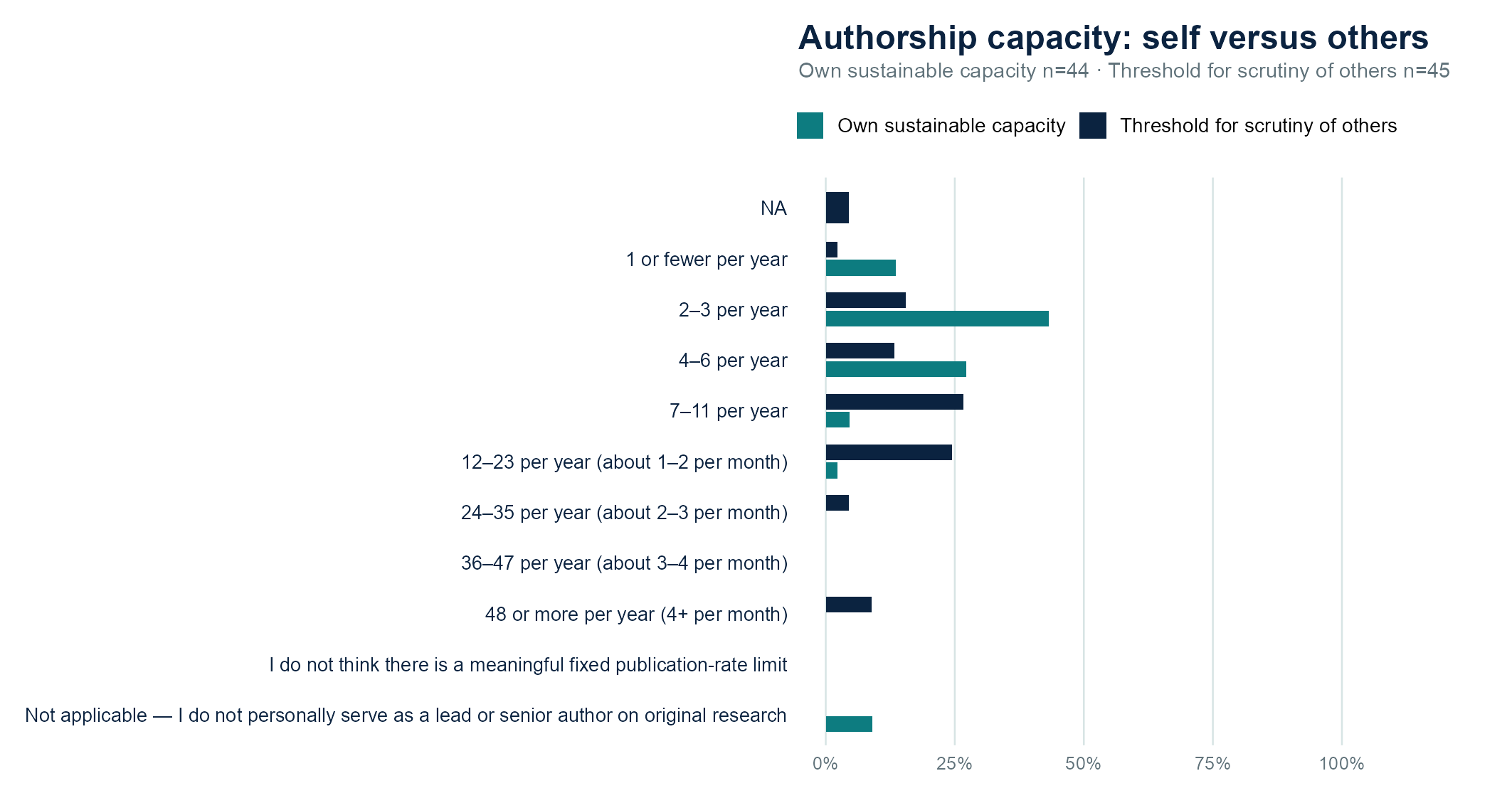
Thinking about your actual professional responsibilities—including clinical, research, administrative, teaching, and other work—what is the highest sustained rate at which you believe you could serve as a lead or senior author on original research papers while still meeting the intellectual contribution, critical review, final approval, and accountability responsibilities expected of that role?
n = 44
Single choice
Scenario: For these questions, “lead or senior author” means an authorship position that ordinarily signals substantial intellectual responsibility—for example, first/co-first or senior/last author, where applicable. Think about a publication rate sustained over several years rather than a single unusually productive year.
1 or fewer per year
14%
6 / 44
12–23 per year (about 1–2 per month)
2%
1 / 44
24–35 per year (about 2–3 per month)
0%
0 / 44
36–47 per year (about 3–4 per month)
0%
0 / 44
48 or more per year (4+ per month)
0%
0 / 44
I do not think there is a meaningful fixed publication-rate limit
0%
0 / 44
Not applicable — I do not personally serve as a lead or senior author on original research
9%
4 / 44
Community survey
Without knowing more about a person's role or circumstances, at what sustained rate of lead or senior authorship on original research papers would publication volume alone prompt you to look more closely at whether the responsibilities of authorship were actually being met?
n = 45
Single choice
Scenario: For these questions, “lead or senior author” means an authorship position that ordinarily signals substantial intellectual responsibility—for example, first/co-first or senior/last author, where applicable. Think about a publication rate sustained over several years rather than a single unusually productive year.
1 or fewer per year
2%
1 / 45
7–11 per year
27%
12 / 45
12–23 per year (about 1–2 per month)
24%
11 / 45
24–35 per year (about 2–3 per month)
4%
2 / 45
36–47 per year (about 3–4 per month)
0%
0 / 45
48 or more per year (4+ per month)
9%
4 / 45
Volume alone would not prompt additional scrutiny
4%
2 / 45
Delphi · Results for the reserve case
4 result items
The Delphi case remained in reserve and was not discussed in the recorded meeting. Its survey responses are preserved here.
Panel-participant question
How much weight should substantive participation in a Delphi or consensus process carry toward authorship?
n = 25
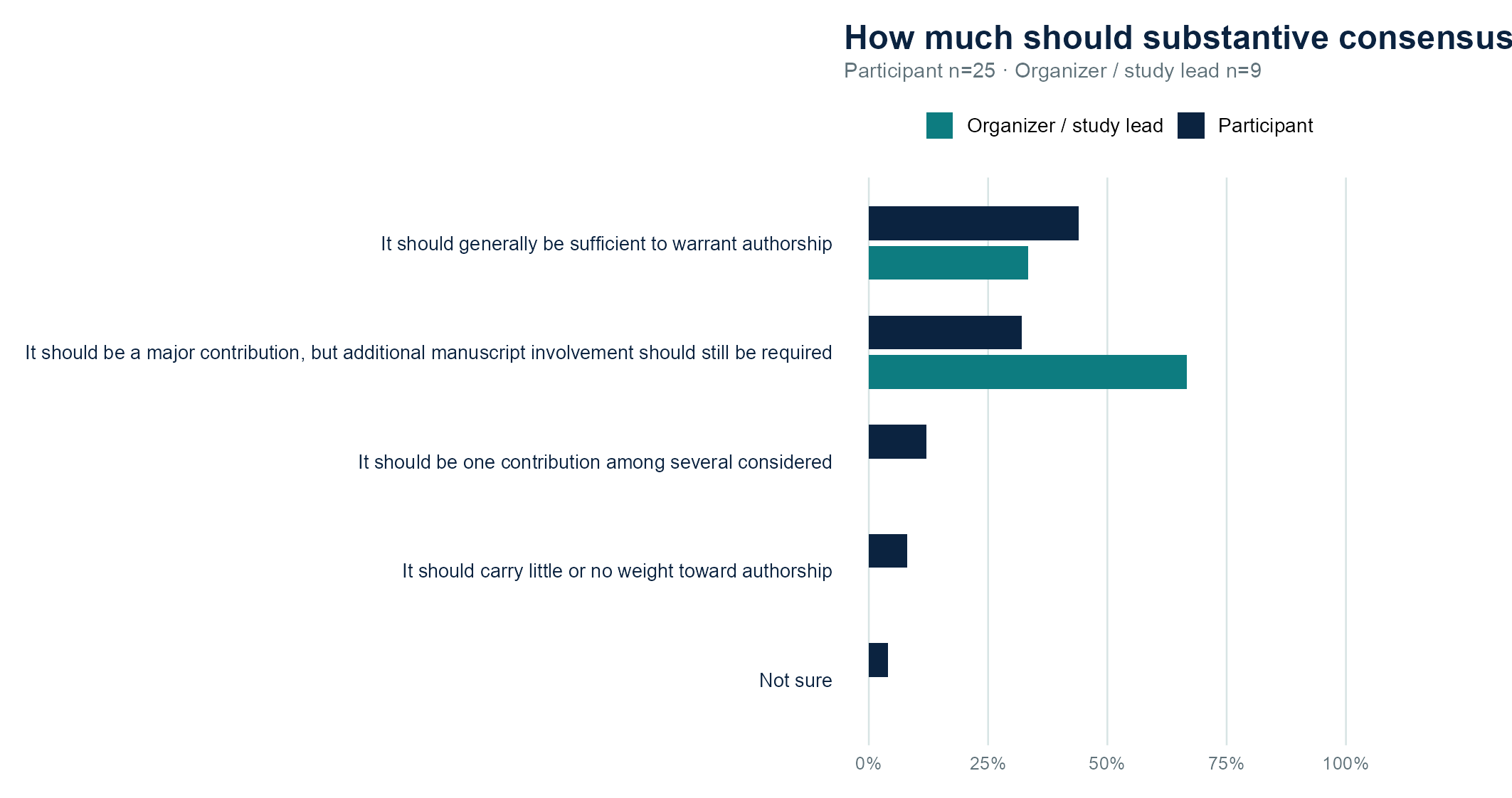
Single choice
Scenario: A Delphi or consensus project includes a group of experts who complete multiple rounds of rating, commenting, and refining statements. Their input helps shape the final recommendations. A smaller writing group then analyzes the results and prepares the manuscript.
It should generally be sufficient to warrant authorship
44%
11 / 25
It should be a major contribution, but additional manuscript involvement should still be required
32%
8 / 25
It should be one contribution among several considered
12%
3 / 25
It should carry little or no weight toward authorship
8%
2 / 25
Panel-participant question
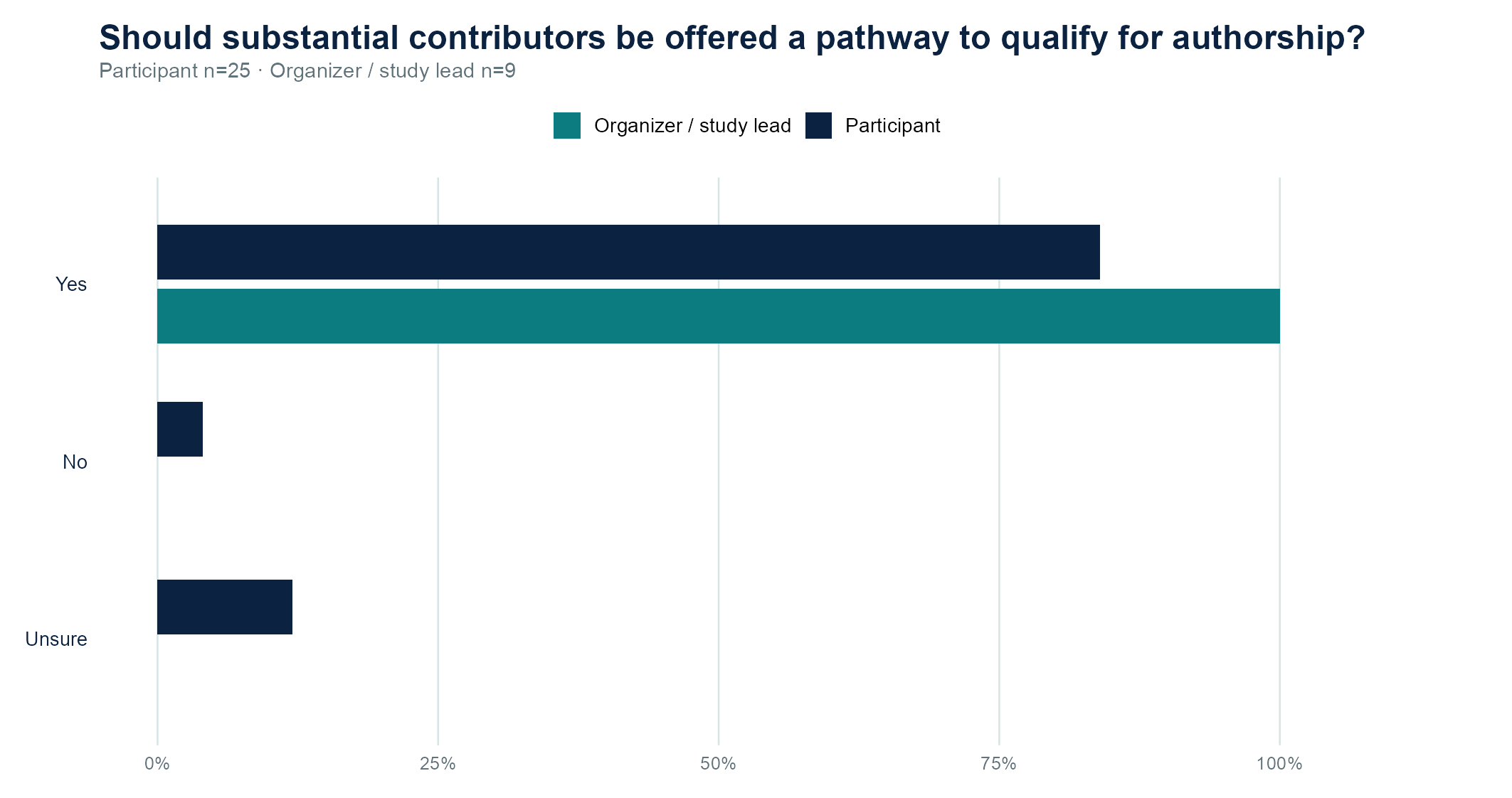
If a participant's consensus contributions were substantial but they had not yet met the full authorship criteria, should they generally be offered an opportunity to review or revise the manuscript, contribute intellectually, and qualify for authorship?
n = 25
Single choice
Scenario: A Delphi or consensus project includes a group of experts who complete multiple rounds of rating, commenting, and refining statements. Their input helps shape the final recommendations. A smaller writing group then analyzes the results and prepares the manuscript.
Panel-organizer question · Topic heading
Organizer perspective: the weight of substantive Delphi participation
n = 9
Single choice
It should generally be sufficient to warrant authorship
33%
3 / 9
It should be a major contribution, but additional manuscript involvement should still be required
67%
6 / 9
It should be one contribution among several considered
0%
0 / 9
It should carry little or no weight toward authorship
0%
0 / 9
Panel-organizer question
If a participant's consensus contributions were substantial but they had not yet met the full authorship criteria, should the writing group generally offer them an opportunity to review or revise the manuscript, contribute further, and qualify for authorship?
n = 9
Single choice
Scenario: A Delphi or consensus project includes a group of experts who complete multiple rounds of rating, commenting, and refining statements. Their input helps shape the final recommendations. A smaller writing group then analyzes the results and prepares the manuscript.
Counts, denominators, and proportions come from the aggregate export dated 2026-10-28 19:48:06 EDT. Percentages are rounded for display; bar lengths use the supplied proportions. Exact catalog wording is used for 32 items. The remaining 17 available items have descriptive topic headings and retain the exported answer labels.
Additional archived comparison figures
7 figures from the supplied pre-meeting image archive
Record and references
This recap draws on the meeting transcript, supplied chat excerpts, and the manifest-linked survey figures. Participant perspectives are paraphrased unless quotation marks are used. The exchange included disagreement and did not produce a formal consensus statement.
-
ICMJE: Defining the Role of Authors and Contributors.
-
COPE: Authorship and contributorship.
-
CRediT: Contributor Role Taxonomy.
Society of Cutaneous Oncology Research Workshop · October 28, 2026